[00:00:00] Speaker A: Just a quick word of warning for our listeners out there before you get into this episode. It is a bit different in its format, which we explain in the show, but also we are going to be discussing things like World War II, the Holocaust and its impact on the Jewish community in Amsterdam. So if you've got little ones in the car or you'd prefer not to hear about those topics, feel free to skip ahead to our next episode. But for now, we're excited to bring you this new kind of episode on the DCL Duo Podcast.
[00:00:28] Speaker B: You know, you can see amazing museums with amazing artwork all over the world.
This, to me, this is more important than doing that.
[00:00:38] Speaker A: All of you out there should recognize that voice. It's Sam. She's a co host of the show and she's also my wife. She said it at the end of a long day in Amsterdam when neither of us really knew I'd ever use it. I'm putting it first because if you listen to our show, you already know what it sounds like.
We talk about Disney Cruise Line a lot, talk about adventures by Disney a little, and some other cruise lines, staterooms, excursions, dining, whether Palo brunch is worth it. We've done almost 700 episodes of those kinds of shows and I'm sure that we will do 700 more. This is not one of those shows. In fact, I don't think anybody in our corner of the podcast world has made a show quite like this one. So I want to tell you why we did.
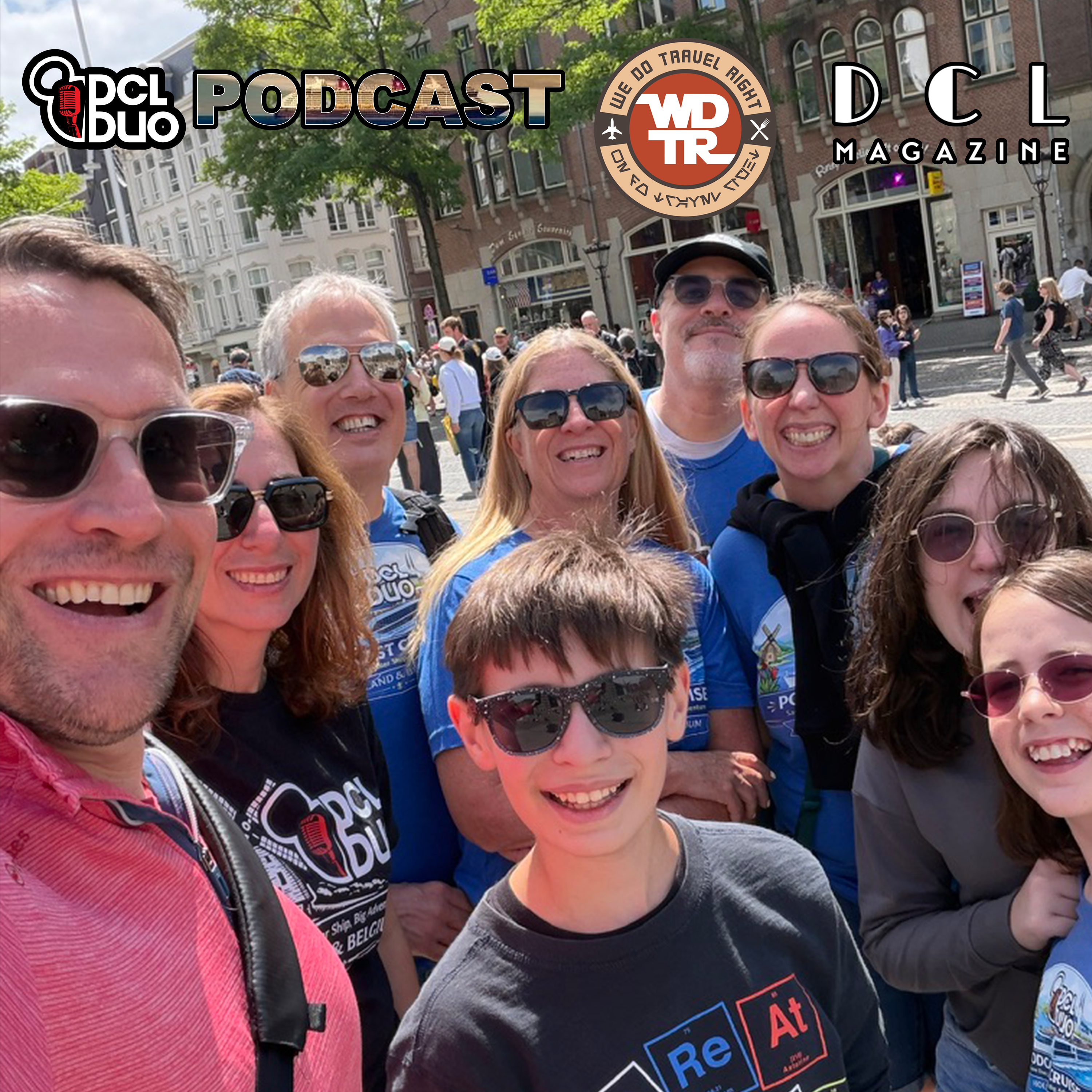
First, I got into podcasting because I love listening to podcasts and one of my favorite podcasts is this American Life. I love the way that Ira Glass and his entire team tell stories. Not just about what happened, but how it impacted real people. And I've always wanted to make an episode like that, but that's hard because we can't just go up to people on cruise ships and ask them about how the experience is impacting them. And so our podcast Cruise Version 2.0 that you all heard about in our live episode provided a unique opportunity for us to put this kind of show together. Last month when we sailed through Holland and Belgium, we did it with a group of listeners and longtime friends, people we felt comfortable interviewing on the show in this way. So we sat down with them and we asked them not just about what they did, but why they did it and how it impacted them.
This particular episode is the first in a two part series. It's going to cover the three days we spent in Amsterdam with our friends before we boarded our river Cruise with Adventures by Disney Disney. In a few weeks, we'll have another episode out about that sailing in a very similar format with some of our listeners who joined us. But for now, I want to focus on Amsterdam.
A brief note about how we made this episode, if you don't mind me, the plate?
[00:02:40] Speaker C: Yes, please.
[00:02:42] Speaker A: We didn't have access to our full studio or a bunch of fancy equipment. Instead, we sat down in hotel rooms, coffee shops and restaurants and asked our friends about what had just happened to them and how it made them feel.
What struck me most is that every one of our friends in this episode described the same moment. Not the same place, the same moment.
That moment. The half second before you decide whether you're going to do something or not.
You're standing in front of something new. A doorway, a staircase, food you haven't tried before. And part of your brain says, I don't know if I can do this one.
This show is about that moment. So today's show is in three parts. It covers three days, three stories, three families, one city, and one moment when you stand at a precipice and ask, is this a bridge too far?
[00:03:39] Speaker D: It was surprising to see ones that where they had been, like, executed right after they were delivered and they hadn't even lived for one day.
[00:03:51] Speaker A: That's Nathan, my son. He's 12, wrestling with a tour of the Jewish quarter in Amsterdam that would be emotional for most adults.
[00:04:00] Speaker E: I'm always a little bit anxious about what's going to be, but I did have some breakfast this morning, so I knew that I wouldn't starve to death.
[00:04:07] Speaker A: That's Tracy. Tracy's our friend. She's also a picky eater. We're going to explore just how picky as she experiences a food tour of Amsterdam that got more than a little adventurous for her.
[00:04:18] Speaker C: Also, they were, like, quiet for, like, two years and I can't be quiet in two minutes.
[00:04:26] Speaker A: And that's Emma. Emma is 11, describing the experience just outside of a bookcase at the Anne Frank House. From the DCL Duo, I'm Brian. Stay with us.
Welcome back to today's show. Let's start with Act 1, the passport.
Leading into World War II, Amsterdam was a haven, a city of tolerance, a city of refuge, including for Jews fleeing other parts of the world to find home. The Jewish cultural quarter in Amsterdam is about four blocks. You can walk it in 10 minutes if you don't stop. A synagogue from the 1600s, a museum inside another synagogue across the street, and a memorial that opened in 2021. All within sight of each other. We went on a Tuesday morning in July in a cold rain.
[00:05:32] Speaker B: Well, the reason I picked this tour was kind of twofold. One, you know, Nathan and I are both Jewish, and I think it's important for us to know the history of the Jewish people wherever they lived.
And the other was, I am the granddaughter of Holocaust survivors and hearing about how the Jewish community here in Amsterdam was affected by the Holocaust and essentially decimated. Only, I think 20% of the Jews that lived here survived, and most of them didn't actually even come back to Amsterdam. But hearing about that history and then also hearing the story of sort of rebuilding and the. The Jewish community in Amsterdam is, you know, back and thriving, of course, not where it was Pre World War II. But that's important to me. And important to me to make sure Nathan understands that history as well.
[00:06:27] Speaker A: To put it in perspective, three quarters of the Jews who are living in the Netherlands during World War II did not survive the Holocaust.
That's the highest proportion anywhere in Western Europe.
Not Germany, the Netherlands. In a country everybody thinks of as the one that hid people, including Anne Frank.
[00:06:47] Speaker B: Jews across the world have a history of diaspora, meaning of movement, of having to leave places that they've lived. It's really something that's kind of, like, born within us, like this idea of always having a passport, this idea of understanding the movement of the Jewish people and how they were either integrated or not integrated into whatever place they lived. My grandmother's family was actually from. My maternal grandmother's family was actually from the border of Greece and Turkey, and so they were Sephardic Jews. My maternal grandfather's family were from Poland. And then my paternal grandparents were both also from Poland. But my. Both my paternal grandparents were Holocaust survivors. They're both deceased now. My grandmother was a young teen at the time the war broke out. My grandfather was a young adult when the war broke out. And both of them are the only two survivors, or were the only two survivors from each of their immediate families. My grandfather was the only survivor from all of his family that we know of. And then my grandmother was able to find some second cousins in France, but none of them returned to Europe.
[00:08:03] Speaker A: I had to let that sink in for a second because for me, that's two people. Each one, the last of their family, became the seeds of the family that I have today. Sam's grandparents did eventually make their way to the United States and settled in New York, where Sam grew up on Long Island.
[00:08:20] Speaker B: I grew up in a town that was 40 to 50% Jewish. If my town was, like, all Jewish and all Catholic, but on Long island. Because everybody knows, like, when the Jewish holidays are, everybody gets taught Holocaust, you know, history and World War II history.
[00:08:35] Speaker A: While Sam grew up on Long island with a large Jewish community, and I grew up in Kentucky with a large Catholic community, experience is very different for our son. We live in Seattle now, and while there is a Jewish community here, it's not quite the same.
[00:08:48] Speaker B: But I would say his experience is more similar to the Dutch Jewish experience, where there are sort of pockets of Jewish communities, but the everyday regular life.
You're certainly very much so a minority, but it's really different than growing up in a place like New York where you can't, like, walk a foot without running into another Jewish person.
[00:09:12] Speaker A: One other important aspect you need to know about Sam's experience as a Jew as we proceed through Act 1 here is that Sam's not super religious.
[00:09:23] Speaker B: Yeah. So I am. I'll call myself an agnostic Jew. That's probably a better way to describe me than secular. But we are more secular in the sense that, like, we're not a very religious family, but we're. We belong to a Reform Synagogue, and Reform is sort of the more liberal end of the spectrum of Judaism, meaning we don't observe Judaism in a strict way.
And a lot of reformed Jews, like me and Nathan, are agnostic, meaning we don't really believe in a God. We're just not, like, we're not sure what there is or isn't. And so we aren't sort of ready to say we're atheists. Because who knows? Maybe there is a God. Who am I to say? Right?
[00:10:04] Speaker A: But even though Sam considers herself to be agnostic in her own words, being Jewish is still very central to who she is.
[00:10:12] Speaker B: But my Judaism is really important to me for a couple of reasons. And the fact that we're part of a Jewish community is important to me for those same reasons, which is, you know, we are this minority that has this history of survival, right. Every holiday we like to joke and say, each holiday is a celebration of somebody tried to kill us. We survive. Let's eat. Right? Let's celebrate. I also very much believe in the Jewish values.
There's this saying is called tik tikkun olam, which means to heal the world. And it's about doing, you know, charitable works to make the world a better place. So doing things like cleaning up a local park, like doing things like donating to charity, doing public good, being involved in public service. My whole career has Been in public service. So all of these Jewish values are really important to me. And then to be fair, I just really also enjoy some of the Jewish holidays and sort of the family and togetherness of it all. I would say it's similar to the way that non practicing Christians view Christmas in that it's part of their upbringing, it's part of their tradition. So even if they're not religious Christians, they like to celebrate Christmas because to them it sort of symbolizes family and together and, you know, a beautiful season and decorating and things like that. So that's a lot of where my like Jewish culture and want to raise Nathan Jewish comes from.
[00:11:37] Speaker A: The first stop on our tour was the Portuguese Synagogue.
For those not familiar, the Portuguese Synagogue was finished in 1675 and has never had electricity. It has never had heat. Slept by candles, more than a thousand of them in brass chandeliers the size of small cars. We walked into it out of a cold rain in July and it was not warm inside.
It's been that way for 350 years.
[00:12:09] Speaker B: Well, so I didn't realize that the congregants, the original congregants of the Portuguese Synagogue were essentially conversos. So people who lived under the Spanish Inquisition in Spain and Portugal and who had to convert to Christianity, who had to basically live as practicing Christians and hide their Jewishness. And then they came here later on and had to, like, learn to become Jewish again.
I was also surprised by the fact that the synagogue is actually not very ornate. But this one was really, really plain. And our tour guide was telling us it's. It's very similar to the architecture for the Protestant churches. There's no stained glass windows, you know, with colors and symbolism and things like that. So that was quite interesting to me. And the front of the building's quite plain. Most synagogues will have some Jewish symbol on the front, like a Star of David is the most common.
This one did not. It just had sort of a Jewish inscription over in Hebrew over the. Over the front door. Basically.
[00:13:15] Speaker A: Sam noticed the building doesn't announce itself. No Star of David, no stained glass. A synagogue built to look like the churches around it. The people who built it were the children and grandchildren of conversos. Families who'd spent generations in Spain and Portugal pretending to be Christian in order to stay alive. Generations that still reside in Amsterdam today and generations that spread throughout the world to bring Judaism to places like New York.
When they built the Portuguese Synagogue, it was a monument of people who thought they had finally reached a country they could call home.
And the synagogue they built, it was
[00:13:51] Speaker B: honestly just really surprising. I wouldn't say it's not like, awe inspiring. It's not like when you walk into.
In the Vatican. It's not like when you walk and see Michelangelo, you know, Michelangelo's frescoes on the ceiling. It's not like that. It's very much like. It's very interesting to see. It's very open and cavernous. It's surprising, you see. You know, because you see the balconies, which are. Where. It's an Orthodox synagogue, so the women and the men sit separately. That's very different than the synagogue that we go to.
But yeah, I wouldn't say it was like, awe inspiring or anything like that. Like what you think of when you walk into some grand, beautiful cathedral. It was more just like, interesting and kind of this cavernous. There were real. These really ginormous chandeliers, and those were kind of. You know, those were very beautiful and striking because they're just tons of candles in there. They don't have any electricity and heat in that building.
And that's in part because of the Orthodox practice. But it's. It's really quite interesting. And I would actually think that. Be very beautiful to go there for a Friday night service when it's all lit by candlelight and.
[00:15:05] Speaker A: How did it strike, Nathan?
[00:15:07] Speaker D: I found it. It was very, like, plain.
Like, it didn't. I didn't really feel much, like, inspiration or anything about it. It was very like.
Like, if you were to imagine what, like, architecture from the 1600s would look like inside of a temple or synagogue or church, it was very, like, plain, but it was very detailed in how they sculpted things like the chandeliers and the ceilings.
There was a lot of detail in it, but at the same time, it was the kind of. It was the kind of thing you would assume to see if you were looking at 1600s architecture.
[00:16:08] Speaker A: Nathan's familiarity with synagogues comes from back home in Seattle, where he's preparing for his own bar mitzvah next year. A big moment in Judaism when a boy becomes a man.
Nathan, you're getting ready for your bar mitzvah next year.
Did anything about the tour today make you more excited or less excited or.
[00:16:31] Speaker D: I didn't really find much connection because.
Because the.
Because my bar mitzvah is gonna be a lot different since it's in.
It's on the other side of the world.
So it won't be too similar in, like, how it will look.
But it does still teach me about how they used to do things in, in Judaism, in other parts of the world.
[00:17:11] Speaker A: Even though Nathan didn't fully grasp the connection or see the parallels, they weren't lost on Sam.
[00:17:18] Speaker B: But we saw a certificate of a boy who had become a bar Mitzvah at age 13 in 1942. He was the same age as Anne Frank. He was born the same year, 1929. And to think that essentially during a time where Jews were being rounded up from Amsterdam and sent off to camps where some would survive and many would perish, there were still Jews living life and having bar mitzvahs and there were Jews getting married. We saw a marriage certificate from that time period as well.
It's kind of amazing to think that some people were able to even save those items.
[00:18:00] Speaker A: To put it into context, the height of World War II in 1942, 12 year old boy became a Jewish adult.
My son is 12, he'll be 13 next year.
The Nazis took the Netherlands in five days, four more than Hitler thought it would. May of 1940, they bombed Rotterdam flat and the country surrendered the next morning.
The next stop on our tour was across the street from the Portuguese Synagogue.
It's a memorial.
It opened in 2021.
It's a maze of brick walls that you can't see over. And as you walk between, you notice that each brick, every brick has a name on it from above. The walls spell four Hebrew letters. They mean in memory of.
It's outdoors.
There's no roof.
We were there in the rain.
[00:18:57] Speaker B: It's just, you know, over 100,000 names on these walls and there's some still unknown. Right? If their entire family perished, then who was there to even report on who died?
[00:19:08] Speaker A: Sam's not exaggerating there. In fact, the wall contains the names of 102,000 Dutch Jews who were murdered in the Holocaust with no known grave.
One brick each, their name, their age and where they died. The wall includes the names of grandparents, parents, brothers, sisters, children and newborns alike. In fact, there's a wall that has a thousand blank bricks on it. Or at least that's how it started. As they find and discover more victims of the Holocaust were Jews from the Netherlands who died, they etched their names on those bricks. A wall of a thousand blank bricks filling slowly over time.
[00:19:54] Speaker B: That was really impactful because some of these kids that were on that had perished were not even of bar Bat mitzvah age. I mean, there were, you know, Nathan is 12 and there were lots of 12 year olds on that wall.
Honestly, it was gut wrenching. It was gut wrenching I mean, it's a really important reminder. It's like one of these things where I feel like whenever we go to a city, I need to see something. Right?
A city in Europe. I mean, there's evidence of the Holocaust throughout most of Europe.
Yeah, I mean, it was. I. I decided to go look for my name, for my last name. Canner K. My last name in English is spelled K N N E R.
But it probably was the same as the name K A N E R. So just one N.
And so I went and I looked and of course I found many people with the same last name and then other sort of variations of the name as well.
[00:20:53] Speaker A: Gut wrenching is how Sam described it. And I don't know that there's a better word when you're standing in the rain looking for your last name on a wall of the dead.
It took her a while.
There were a lot of them.
[00:21:09] Speaker B: The hardest part. The hardest part is just seeing the. The names with years that are younger than adults. Right. Like seeing, you know, one year, two years, three years, five years. Seeing, seeing names of children is always, always the hardest.
[00:21:31] Speaker D: Yeah.
It was surprising to see ones that. Where they had been, like, executed right after they were delivered and they hadn't even lived for one day.
I think it was just seeing, like, how young some of the people were and like how the Nazis kind of took advantage of how there were. Of how the people who were very young and very old couldn't defend themselves or run away.
[00:22:10] Speaker A: A short walk away, we found our last stop on the tour, the Amsterdam Jewish Museum.
It was originally opened in the 1930s, but most of its collection was confiscated during World War II.
It reopened its doors in 1955 and slowly expanded, moving to the current synagogue complex location in 1987.
It centers on four different a great synagogue, an Upper Synagogue, a new synagogue, and a third synagogue, none of which are in active use today.
It's also, frankly, a wealth of information about what it was like to be Jewish during the war and even before.
I learned a lot, but so did Sam and Nathan.
[00:22:52] Speaker B: You know, it's. There are a couple of really interesting things you post World War II, they have collected an incredible number of Torah coverings. The Torah is the. The first five books of Moses. So it's the Jewish Bible and it's a scroll and there's these beautiful, ornate, like, covers and these kind of silver adornments that you decorate your. The Torah of a synagogue with. And they were able to find ones that had been hidden and find Torah scrolls that had been hidden because most of these things were destroyed by the Nazis.
But yeah, they had this, just this beautiful rich collection of these items and some, and some menorahs, these like ginormous menorahs. And I can't imagine where some of these were hidden. Some of these are also reclaimed from the Nazis. Right. Because the Nazis stole all these things from Jews, particularly if they were of value, you know, financial value. So things made of silver, for example, or other precious metals.
Yeah, so that was like, really, that was incredible to see. Just like such a rich collection.
They also have a really large library collection. The tour guide was telling us of all these different, you know, Jewish works. And so that was, that was really interesting to see. The other parts were just learning more about the, you know, the history of Jews and learning about, you know, Pre World War II, these sort of two groups of Jews, and as I mentioned, the Sephardic Jews and the Ashkenazi Jews. But what I didn't realize, I understood that they maybe lived these separate lives. But what I didn't realize, understand was the Portuguese Jews, the Sephardic Jews tended to be sort of upper class, wealthy, whereas the Ashkenazi Jews were essentially at the poverty level. So that was just an interesting piece of history I didn't know about.
But Jews were expected to still sort of take care of their own, to take care of other Jews. So through taxation, through the government, things like that, the wealthy Jewish community ended up supporting a lot of the. The poor Jewish community who really had no upward mobility because they couldn't become parts of the working class or the guilds. They weren't allowed to be a part of most of the guilds. So it's super interesting to hear about how just this dichotomy between these two communities.
[00:25:22] Speaker D: Well, I learned about how, like, the Jews would be like, not allowed to join most guilds, so they would have to become like doctors or pharmacists, because those were the few jobs that they could get into the guilds for.
Because most of the other ones, they either weren't wealthy enough or just weren't, like, wouldn't the people wouldn't let them into the guilds.
[00:26:01] Speaker A: The Portuguese Synagogue, the Jewish Memorial and the Jewish Museum are by far not the only markers of what happened during World War II.
I've experienced this before, but generally, Europe is not one who wants to forget this moment. In fact, they want it to never happen again.
One of the more interesting memorials that we saw throughout our trip were the Sulperstein. For those not familiar, the Solperstein Are stumbling bricks, essentially small brass plaques set into the pavement at the last address a Jewish person freely chose to live. Tens of thousands of them across Europe, all funded through private donation.
You don't visit them, you trip over them on the way somewhere else.
That's the design to ensure you not only never forget, but hopefully that it never happens again.
[00:26:56] Speaker B: And you know, one of the other things we saw were those stumbling stones. For people who don't know, the stumbling stones were. They're a more modern day project, but basically for people, not just Jews, but for people who perished from the Nazis in the Holocaust, there are these stones and they're all throughout Europe, but very much in this part of the world, in particular, very much in this part of Europe, in this part of Eastern Europe.
And there's a stone marker and it's supposed to be essentially the last place where that person lived or was known to live.
[00:27:31] Speaker A: One of the hardest parts about doing a tour like this in the morning in the rain.
It's heavy. It's really heavy. It's emotionally heavy. It's emotionally heavy for me. It was emotionally heavy for Sam and it was emotionally heavy for Nathan.
But perhaps what impressed me most about Nathan and Sam was that both of them somehow found hope in a story where very little hope can be found.
[00:27:55] Speaker B: I mean, I always find hope in the story of survival of Jews, right? Everybody, as I mentioned, every holiday is they tried to kill us. We survived. Let's eat.
I always find hope in that. I also find hope here in Amsterdam because there are places like Amsterdam, There are places like Munich and Germany. There are places where there are larger concentrations of Jewish people who are living and practicing their Judaism in whatever way they are comfortable with.
But they're also accepted into the greater community and they're part of everyday life. And so that's what gets. Gives me hope and inspiration for the future and to think that the future will be better than the past.
On the other hand, there's always the fear, right? So it's like a combination of things. When you come out of a day like this, you think about like, oh, if it happened once before, could it happen again, right? So there's. There's this combination that's this, you know, with even within me that is in conflict with one another.
[00:29:04] Speaker D: I found it cool how we got to see one of the seedlings of the Anne Frank chestnut tree on our tour.
It's cool to see the descendants of a tree planted by someone that were. That was admired and planted by someone during a time where they could have been killed.
Yeah, I'm glad that we did this, and I would recommend this to other people because I find it very educating on Jewish history.
[00:29:43] Speaker B: I'm really glad that we took this. I'm really glad that you were willing to go with us on this, Brian. As the non Jew in our family, you know, it's kind of heavy to choose to do, you know, a very, you know, half of a day spent doing a Jewish tour of Amsterdam knowing that you're going to be visiting, you know, Holocaust Memorial and hearing about that history in particular.
So I just appreciate that you were willing to go with us on this. I'm also very appreciative that we're going to go to the Anne Frank house, which I have been to, but it's been over 20 years. I think it's important that we take Nathan there.
You know what? I'm actually really interested to hear your thoughts, Brian, on the tour, because it's
[00:30:29] Speaker A: not an editing flub that Sam was cut off mid sentence there. That was me grabbing the microphone from her and actually handing it over to our son at the time to talk through some of what he thought about.
And here we've arrived at the moment. I've been discussing the precipice, the door I just wasn't ready to walk through at the time.
The answer I couldn't give in that moment as we were sitting together talking about the day.
Instead, my wife pointed the microphone my direction. I changed the subject, but I want to answer her now.
I'm not Jewish. I married into this, and for most of my life, I understood this history the way you understand something you read a terrible thing that happened to other people a long time ago somewhere else.
Sam's father's parents were both from Poland.
Both of them were the only person in their immediate family to come out the other side.
Not the only one they knew of.
Only one.
Two people, one on each side of a marriage that hadn't happened yet.
Here's what I was holding the whole time we were in that quarter and did not say when. Sam asked if things had gone the way the Nazis had wanted during the war. Not most of the way, the whole way. Then Sam's grandparents don't survive. And then Sam's father is never born. And then Sam is never born. And then Nathan is never born.
The two people I love the most in the world simply don't exist.
Not we never met. Not my life goes differently.
There's nobody to meet. There's no one there.
And the margin on that was two People.
As I was standing in the rain watching my wife look for her own name on a wall of 102,000 names, it couldn't have been more real for me. The whole purpose of the Nazis during World War II was to ensure that these two people that I love so much never existed.
And for one reason.
Because they're Jewish.
That's it.
That's the whole reason.
There is no second half of that sentence. There's nothing else in it. I keep looking for the rest of it, and there isn't any. I couldn't say that then. I don't think I could have gotten through it with our son sitting right there.
So I deflected.
I didn't walk through the door. I wasn't ready.
Even if I'm ready today. Ultimately, I agree with my wife, and I think it was important for Nathan to experience this tour. It was important for me. I learned a lot, as did Sam, and I think it's a worthwhile experience for anyone visiting Amsterdam.
So if you're interested, we'll link to the specific tour provider in the show notes for this episode. It's called A Jewish Tour of Amsterdam, and we found it through Trip Advisor. Our guide was excellent, and it was time and money well worth spent.
Fittingly enough, we ended our tour in the museum cafe, enjoying one of my favorite Jewish delicacies, latkes with sour cream and applesauce, which seems like the perfect segue to Act 2.
Stay with us.
All right, welcome back. Thanks for hanging with us through Act 1. That was a heavy, heavy portion of the show. But we're gonna get into some more fun topics here in Act 2.
Specifically, our friends Tracy and Michael came to the rescue after a really emotionally heavy day touring the Jewish Quarter. And with the prospect of us headed to the Anne Frank house later in the evening. On our second day, Michael and Tracy booked us a food tour through Amsterdam. And it was just the perfect break for what were two emotionally heavy tours.
So let's start where we started, the Albert Cup Market.
Our friend Michael's been cooking since he was 8 years old, not helping in the kitchen, cooking dinner for his family.
[00:34:30] Speaker F: I started cooking our family meals at 8 years old following the Frugal Gourmet. And I wasn't the one that did the shopping, so I had to go based on what mom had bought at the grocery store that week and what we had available in a pantry. So I learned early on to improvise and adjust recipes not only for what it was and what I wanted to have, but the ingredients we had on
[00:34:58] Speaker A: hand the Frugal Gourmet was a cooking show on PBS, huge to the 80s. So picture Michael, 8 years old, standing on a step stool running the family dinner off whatever the TV chef was making and whatever happened to be in the pantry that week.
That kid grew up into the person at the table who orders the thing nobody else will. Food isn't fuel for Michael, and it isn't a comfort zone, he defends. It's the whole point of going somewhere, hand him a menu in a language he can't read, and he's delighted. The not knowing is the fun, which, keep in mind, is the exact opposite of his wife. But we'll get to Tracy in a bit. For now, just know that when a food tour promises four hours of things you have never tried, Michael is the person it was built for.
[00:35:39] Speaker F: I see recipes more as an idea.
[00:35:43] Speaker A: And
[00:35:45] Speaker F: I can see in my mind knowing what I can get and how to adjust for what's available locally.
[00:35:51] Speaker A: What's available locally? Remember that phrase? Because Michael just booked a food tour in a city that has turned what's available locally today, right now, into an entire way of life.
The tour started at a store called Hima.
If you've never been to the Netherlands, Hema is less of a store than a national institution. It's in every Dutch downtown and every train station. It sells houseware, socks, school supplies, underwear, a hot lunch, all under one roof. It was founded in Amsterdam in 1926, and here's the part that it was built as a fixed price store. Everything cost one of a handful of set prices. No haggling. The name is an acronym that translates more or less to the Dutch Standard Prices Co. Of Amsterdam.
And then there's the cake.
The thing we tried at Hema was a tompouse. And if you want to understand the Dutch, you could do worse than to start here. A tompouse is two thin layers of crisp puff pastry with a slab of vanilla cream in the middle. It's topped with a sheet of glossy pink icing. It is the Dutch celebration cake. Birthdays, weddings, and especially King's Day, the national holiday for the King's birthday. And on King's Day, the icing isn't pink cake, it's orange. Because the Dutch royal family is the House of Orange. And the whole country turns orange to celebrate them. The flags, the clothing, the face paint, and of course, the cake.
Now, the tompous is thoroughly Dutch. The glaze, the fixed rectangular shape, the name. But the idea underneath it isn't two layers of Puff pastry with cream between them. That's French. It's called Emile Foyer.
It means thousand layers, and it probably goes back to the 1600s. So the tompous is really the Dutch cousin of the Mille foy. Americans call it a Napoleon. What an Amsterdam Baker did around 1858 was take that French idea and make it unmistakably Dutch.
The name is its own small story. The baker took it from a performer, a Frisian man who billed himself as Admiral Tom Pouce, which is French for Tom Thumb itself, a nod to the famous tiny circus star general Tom Thumb, who'd been touring Europe. So it's a Dutch cake built on a French pastry named after a Dutch performer named after an American one. Layers all the way down.
But here's the part our guide told us, and it's my favorite.
Hema didn't invent the tompous, and by their own telling, they almost never sold it at all. The story goes that in 1932, a sales manager in one of Hema's lunchrooms accidentally over ordered pastry. Badly stuck with the surplus, he asked if he could set up a little counter out in the store to move it before it went to waste. It sold out almost instantly.
That accident became Hema's bakery department.
Hema has sold the tompus ever since, and today it moves around 16 million of them a year.
That's against a total population in the Netherlands of 18 million. That's how popular this cake is.
And almost everyone buys it from Hema, no place else.
There is, by the way, a correct way to eat a slice of tompous, which nobody tells you, which is why the first bite always erupts cream out both sides and down your wrist.
Thankfully, our guide gave us the right way to eat the cake.
So what's the secret?
Well, it's pretty simple, actually.
First, you take the top layer of pastry with frosting off of the vanilla cream, move it right to the bottom cookie underneath the vanilla cream, and smush the two together, the icing in between the two cookies.
Now, when you bite through the soft vanilla cream down into the cookie, none of it spills off, and you get to taste everything in one bite.
Tasting Tompus at Hema was the first of maybe a dozen stops, and the guide had a clear philosophy about the rest of them, with one deliberate exception we'll get to in a second. The person running the tour wasn't Dutch, and the way he taught the city was through the little places most tourists walk right past.
[00:40:01] Speaker B: Our tour guide was fantastic on this tour because he really taught us. I think he's not even a native Amsterdam in. He's actually Israeli, but he's lived here for nine years and he was sort of teaching us about the culture of Amsterdam through its food and of course through the international food and influences from, you know, immigrants who have, you know, come here or were brought here.
And it's just super interesting way to discover a new place.
[00:40:31] Speaker A: Discovering a place and its culture through its food, that was the whole idea of the tour. And the thing our guide kept coming back to stop after stop was that in Amsterdam, almost nothing sits around, everything is fresh, because everyone buys their groceries daily to make their food for the day. You could see this most clearly at that one exceptional stop I mentioned, the next stop, and the least family run, least artisanal, least fresh looking place imaginable. A place that is, to an American eye, a vending machine.
Stop 2 is a place called Thibault. But before we get to it, I should mention the drinking, because it started back at Hema and it's going to recur throughout the day.
At the start of our tour, our guide handed each of us a little cup of glue. Wine, hot spiced wine, the kind of thing you'd expect at Christmas markets in December, not on a walking tour that started at 10am but the real fun began when he came back around with a bottle of rum and, and offered to fortify it.
Yeah, I fortified it.
[00:41:34] Speaker F: Most surprising thing was starting out with a spice wine to start, then getting halfway through it and having him add a shot of rum to that as well.
[00:41:46] Speaker A: Fibo, like Hema, is a Dutch institution and it looks to an American completely insane. It's an automat, a wall of little glass doors, each one warm, each one with a hot snack behind it, a croquette. Usually you put in your coins, the door pops open, you take your food and either eat it while you're walking or while you're standing up. The chain started as a bakery on a street called Ferdinand Bulstraat here in Amsterdam. That's where the name comes from, Phi Bo.
And the chain is so popular you can now find automats serving croquettes in a couple of hundred places across the Netherlands.
[00:42:27] Speaker F: What is considered fast food here?
It only means it's fast for you to get. Like the Fibo that we went to, that was the fast food croquettes. It's fast food only in the time it takes you to get it. They actually had a vending machine that you put money into. You get your croquette out. And they explained how in the US we may avoid that because we wonder how long that item has stayed in there and that it's probably been too long. And he explained that every time they put something in the vending machine, they set a timer for 30 minutes. And if it's not gone in that time, they remove it, discard it, and put fresh in. So, you know, whatever you're getting is no more than 30 minutes old.
[00:43:14] Speaker A: We might look at an automat and see the food inside it and think it's been sitting there since Tuesday.
The Dutch look at that same machine and see a 30 minute guarantee. Same machine, two totally different perspectives.
And that I realized later was the whole city in miniature. It's not that the Dutch are relaxed about food, it's the opposite. There's a line and they will not cross it. 30 minutes, not 35.
The whole place is quietly drawing hard little limits everywhere you look and then just refusing to step over them. Hold that thought. It comes back.
So what's actually behind those little glass doors? Well, the star of the Fibo automat is the croquette. The croquettes at Fibo have a cylinder shape. They're breaded and deep fried to a hard, golden crunch on the outside and filled with something the Dutch call ragu, a thick, savory, almost gravy like paste of slow cooked meat, broth, butter and flour seasoned with things like nutmeg and pepper. Crispy shell, molten soft center. That contrast is the entire point. And here's the thing that trips up first timers, including us. When you bite in, the inside isn't a solid piece of meat. It's that smooth, creamy, almost pudding like filling. If you're expecting a chicken nugget, it's a genuine surprise, which is exactly what
[00:44:31] Speaker E: Tracy found, probably the fiba, the fibo, the croquettes, because they had. I didn't try all of them. There were five different kinds that we got. I think, you know, when he described it, it was like mashed potato consistency. And, you know, and I was just like, I don't know about that. But that was probably the one that surprised me the most because they really were very tasty and they weren't greasy like they were deep fried, but they weren't greasy on the outside at all either.
[00:44:59] Speaker A: Tracy's the pickiest eater on this tour.
Much more on that in a second. And she just went to bat for a croquette out of a vending machine. Keep her in your back pocket from Fibo. The tour started Working its way toward the Albert cup market with a stop at a Turkish place along the way.
[00:45:17] Speaker B: At the Turkish place we had like a, a, a grape leaf wrapped. Grape leaf type dish is very similar to what you see in Greek food. That was, I wasn't really into that just because I'm not big on grape leaves. But there was this bread that had feta. It was kind of like a phyllo dough, but made but thicker. I don't remember the name of it, but it had feta cheese in it and that was delicious. I was delightfully surprised by that.
[00:45:44] Speaker A: That was Sam, of course, the grape leaf dish she was reaching for. There is the Greek dolomite and the bread she was describing is called burek.
Throughout the tour, it became apparent how much Dutch cuisine has been influenced by their colonial past.
That was no more apparent than at our next stop, Tokorami.
A toko is an Indonesian grocery and takeaway. The front is a mini market. The back is a tiny kitchen turning out hot food. Tokorami has been on Ferdinand Bulstraat, the same street that gave Fibo its name, for decades. Run by the same family, and it's one of the oldest Indonesian tocos in the city. And why there's an Indonesian shop on a Dutch street corner at all is the real story. Indonesia was a Dutch colony for centuries, the Dutch East Indies, until it won independence in 1949. Indonesian food didn't just follow the migration home, it became more or less the national comfort food food of the Netherlands.
[00:46:43] Speaker B: Oh, the Indonesian food. I forgot to mention there was this like empanada like thing and there was this like sticky rice. There was a sticky rice dish and an empanada. It's. I don't, I don't know what they call it in Indonesian, but it's, it looks like an empanada but it's got glass noodles inside it with the meat and the vegetables. And that was phenomenal. That was probably, that was another, you know, outstanding one that I was very much surprised by. I'd never eaten Indonesian food before.
[00:47:11] Speaker A: I also have to say I really enjoyed the Indonesian food and getting to understand better why Indonesian food is so popular with the Dutch. I'll actually flag here that one of my favorite souvenirs I brought back were some house made sambals from this Indonesian toco. They were fantastic. If you like spicy food and you take this tour, I highly recommend picking some up to bring home as a souvenir.
Alright. This was the midpoint in our tour. After this we started to make our way through The Albert Cup Market, our first stop was for herring.
The herring came from a fish stall just off the market called Volendammer Wieschendal. The family that runs it has been selling fish in Amsterdam since around 1930, and they have their own boats up at the old fishing port of Volendam, north of the city, which is where the name comes from.
For Michael, the adventurous one, the herring was the highlight.
[00:48:02] Speaker F: On the herring, it is a cured fish, so right away they throw it into vats with salt water.
But what we had was very fresh tasting. It didn't have a salty, cured taste, or I eat a lot of smoked mackerel or smoked salmon and it wasn't anything like that. It was more like eating really high quality sashimi. So it, it just had that nice, fresh, lightly fish flavored, not, not a strong odor, not a strong flavor. And, and yeah, there were plenty of people not eating it, so I had several.
[00:48:43] Speaker A: Just for context, you cannot overstate what herring means to the Dutch.
This is not a novelty snack the tour guide trots out for tourists. It's close to a national symbol. The Dutch have been curing herrings since the 1300s, and that fish is a big part of why there's a Netherlands to visit at all. The herring fleets of the Golden Age funded the merchant navy and the trading empire that made this tiny nation a world power. When a Dutch person eats a herring, there's centuries of history in one bite.
A quick myth to clear up. It's usually called raw herring, but it isn't exactly. The fish is cleaned lightly, brined and matured, a traditional method the Dutch call jibbing. So it comes out silky and mild rather than fishy, as Michael noted, not cooked, not quite raw, somewhere in between. The season also matters here, as Michael explains.
[00:49:35] Speaker F: The interesting thing with the herring is that we're here just about a month after the herring season ended here locally.
And what we learned is that in Amsterdam, and probably the Netherlands in general, they have available the herring that was available from the current year, only after that they export it to other countries. So what you get in Amsterdam and the Netherlands in general is always going to be freshest.
[00:50:04] Speaker A: That's the freshness thing. Again, the fibo timer turned into national policy.
The best herring never leaves the country. You get this year's, they ship last year's to everybody else.
The prize is the new catch herring Hallensuh nuva Dutch new landed in late spring and early summer, when the fish are their fattest and sweetest. There's a whole festival for the first barrels called vlagundas. Danke Little flags day when the boats come in dressed in flags. And there are two ways to eat it. The first is the postcard version, and it's a genuine test of nerve. You take the whole filet by the tail, tip your head all the way back and lower it into your mouth from above. That's the classic move. You'll see it on every stand.
The gentler version, and honestly, the more common one in Amsterdam, is to have it cut into bite sized pieces on a little tray speared with toothpicks, with raw onion and pickle on the side. The onions aren't just a garnish, by the way. That's a holdover from the days before refrigeration, when a little sharp onion helped cover the fish that wasn't quite as fresh as this one. And the third option, if the first two may be a bridge too far, is the whole thing tucked into a soft white roll with the onions and pickle sandwich style. Same fish, less theater.
Oh, and I forgot to mention, the herring came with something else.
A drink.
[00:51:24] Speaker F: Then halfway through the food tour with the herring starting out with a shot of a gin like drink, but nobody
[00:51:34] Speaker A: at the table can seem to remember the name.
[00:51:36] Speaker F: Well, actually, probably a grandparent of gin. The.
What was it? Genoven?
Hanover.
Hanover.
J E N.
Jen.
I don't know. Brian will crack this pronunciation of it.
[00:51:54] Speaker A: It's Yanaver.
[00:51:55] Speaker F: Oh, I can't say that I'm not going to try. The Dutch.
[00:51:59] Speaker A: Jenever is the Dutch juniper spirit that Jen is descended from. Gin is more or less what the English made after they got a taste of ye naver. And there's a ritual for the first
[00:52:08] Speaker F: sip, it was in a small shot glass. It's traditionally in a tulip glass and filled all the way to the top. And so our shot glass was filled all the way to the top and it had a special way to drink it first, and that was to put your glass on the table. It's filled to the brim with the liquor. You put your hands behind your back and take the first sip of it, leaning over and sipping it out of the cup. Then you pick up the glass and continue drinking from there. So that was definitely something different and
[00:52:46] Speaker A: unexpected, I might say unexpected and potent. As Michael explained, the glass is filled right to the rim, so full you cannot pick it up without spilling it. So you don't pick it up. You put your hands behind your back and you bow to the drink. An entire nation looked at a glass filled slightly too high. And decided the correct dignified solution was to bow to it. That might be one of the most Dutch things I learned all week.
So that's how Michael met the herring. He ate his and then he ate everybody else's. But Michael isn't the story at this stop. Tracy is.
Remember Tracy? She's a picky eater. Not a little picky. Professionally picky.
[00:53:26] Speaker E: As the resident picky eater, I'm always a little bit anxious about what's going to be. But I did have some breakfast this morning, so I knew that I wouldn't starve to death.
[00:53:36] Speaker A: So what does Tracy like to eat?
[00:53:38] Speaker E: Yeah, I'm pretty much a Midwest palate. You know, beef, potatoes, chicken, rice.
Like, yeah, like, notice there's not a lot of vegetables, there's not a lot of fruit involved in any of that. So very Midwestern kind of, you know, palate would be how I would describe myself when we are cruising Disney Cruise Line pretty much every night. I get steak.
I'm not, you know, the person that gets the fish. I'm not the person that gets the, the sushi. I'm not. I just don't.
And they all make fun of me because my salad preference is iceberg lettuce.
[00:54:15] Speaker A: But here's the thing. Up to this point on the tour, Tracy had gone for it. This professionally picky eater had walked into a four hour tour of a foreign country's food and been her word, brave.
[00:54:29] Speaker E: But I was pleasantly surprised at the amount of things that I tried and really liked. You know, I had to be brave and try things that maybe I wouldn't have normally done. But I tried the croquettes, the beef and the chicken one was delicious. The cheese one was delicious. I tried the different from the hiba, the sweet, anything sweet. I'll try. And so I was pleasantly surprised at the amount of things that I could find on this particular food tour that I really enjoyed.
[00:55:05] Speaker A: Even Sam, not nearly as picky as Tracy, went right up to the edge of the herring and backed off.
[00:55:13] Speaker B: So I was really afraid of the herring. I'm gonna say I was right.
I took a very teeny bite of the herring because that was something I was like, I need to try. But it was a textural thing for me. It wasn't even, I don't know that I even got much of the flavor.
[00:55:31] Speaker A: Sam took the teeny bite. Tracy wouldn't even do that.
[00:55:34] Speaker E: I didn't try the herring though.
That's a bridge too far.
[00:55:38] Speaker A: There it is a bridge too far. All morning, this city has been showing us Its lines. The croquette thrown out at 30 minutes. The herring that never leaves the country, fresh or nothing. A whole culture built on knowing exactly where the edge is and refusing to cross it.
And then Tracy, iceberg lettuce steak every night, professionally, gloriously picky, looked at a raw fish and drew her line in exactly the spot the fishmonger would have understood. Not out of fear, out of knowing herself. The way we usually tell travel stories, the picky eater eats the fish. That's the arc. That's the whole genre. You go somewhere, you're scared of a thing, you try the thing, you're transformed. Roll credits.
But here's what I love, and it's the reason I'm telling you all of this.
That wasn't the end of Tracy's tour. It was the middle of it. She drew her line at the herring, and then she turned around and ate her way happily through the entire back half. Because a bridge too far isn't a failure of adventure. It's finding the one edge you won't cross and discovering that everything on your side of it is still wide open.
After the herring, the tour finally spilled into the Albert cup market itself.
The Albert cup is the largest street market in the Netherlands. It's been running since 1905, right down the middle of a neighborhood called De Pip, the Pipe, which was built as cheap housing for working people and is now one of the most diverse corners of the city. Something like 150 nationalities live in De Pip, about a kilometer of stalls, six days a week. Named after a 17th century Dutch painter whose glowing golden landscapes hang in the Rijksmuseum. I doubt he would have expected a street market to be named after him.
Our first stop was just off the market, a Surinamese shop called Tajens.
Same story as the Indonesian food, just on a different continent.
Suriname, on the northern shoulder of South America, was a Dutch colony until 1975.
Around independence, a huge share of the population moved to the Netherlands and brought a cuisine that's already a mashup of everywhere. Indian, Javanese, Chinese, African, American.
[00:57:41] Speaker F: What surprised me most about the tour was the extent of the international migration into Amsterdam. That Suriname was the furthest away. The country just north of Brazil in South America.
[00:57:55] Speaker A: And what we tried was the most Surinamese thing imaginable, a sandwich. That's basically a Dutch Caribbean, Asian, banh Mi.
[00:58:03] Speaker B: I was pleasantly surprised by the Turkish food and the Surinamese food. So the food from Suriname, it was like a banh Mi type of a sandwich. And it was a. Like a ground chicken. On I'll call it a baguette with pickled vegetables that I thought was really good.
[00:58:23] Speaker A: I have to agree with Sam here. The Surinamese food was fantastic and something I'd never tried before. So I really appreciate the opportunity to learn more about its connection to the Netherlands and to enjoy some of the cuisine.
After to gins, we headed to taste what is probably one of the most Dutch foods you can imagine.
Cheese.
The Americans know Dutch cheese as Gouda, spelled G O, U, D A, and every American says it that way. Gouda. The Dutch say howdah. That throaty Dutch G up front.
Here's the thing most people don't realize. Howdah isn't really the name of a cheese. It's the name of a town. A town that was a marketplace going back to the Middle ages. Farmers from the surrounding pastures brought their cheese into the city of Gouda to be weighed, priced and traded. A right formally granted to the town in 1395.
So calling a cheese Gouda is a little like calling a wine Bordeaux. It's about where it was sold and shipped from.
It's a cow's milk cheese that takes its name from the city, and it's the Netherlands most produced and most exported cheese, which is also why the word got so watered down abroad. In some places outside the Netherlands, Hauda gets slapped on almost any Dutch style cheese, which is why the real thing at a market stall in Amsterdam is a small revelation.
The magic is in the aging, and the Dutch have a precise vocabulary for it. A young howdah is pale, soft, mild and springy. Let it sit and it climbs a ladder of names. Balega, matured, then Aoud, old and passier or so over. Yarik, overaged.
As it ages, the cheese darkens, turns hard and brittle and develops little crunchy white crystals throughout. The same salty, savory crystals you get in a good aged Parmesan.
The flavor climbs the whole time, getting nuttier and sweeter and more caramel, like the longer it goes.
The breadth of the cheese and the difference in taste from aging is something that surprised Sam.
[01:00:26] Speaker B: But the thing that surprised me the most was honestly, the cheese. We went to a cheesemonger in the market and it was, you know, real farm cheese, not stuff you get at the supermarket. And oh my God, the Gouda cheese that we had. And I've never been a good Gouda fan at home, or Gouda as they call it here.
And there was a cow milk Gouda, there was a sheep milk Gouda, and then there was an aged cow milk Gouda. I Mean, they're all aged to some degree, but one that was aged like a year and a half, the sheep milk Gouda was so incredible, I could just eat that by the pound.
[01:01:10] Speaker A: And judging by how much cheese we all sampled, I think all of us agreed with Sam.
Our next stop was to sample. The thing everybody agreed was the best of the day.
Little pancakes from a stand in the market named simply Puffer Jetties.
[01:01:25] Speaker F: The best was probably pancakes. The pancakes I didn't really know about before we got here, but that was a nice sweet surprise.
Really fluffy little pillow of pancakes in butter and powdered sugar. So how can you go wrong with that?
[01:01:44] Speaker B: I mean, I really liked those little pancake type things. I can't remember the name of them in Dutch, but they're these little delicious pancake bites that Michael was talking about.
[01:01:53] Speaker E: The little mini pancakes with the powdered sugar on the top. Because I am a sweet girl, I love sweets.
[01:01:58] Speaker A: You might have guessed it by now, but Pofferty? Well, they're little yeasted puff pancakes cooked in a cast iron plate dimpled with dozens of shallow rounds, flipped with a fork, buried in butter and powdered sugar. The stand and Albert cup has been a fixture in the market for decades.
Poffrajeti are actually one of the most traditional Dutch foods we experienced.
But next up is probably one of the most popular sweet treats from the Netherlands, the stroopwafel.
The stroopwafels came from a stand called Rudy's Original Stroopwafels right in the middle of the market.
There's a real story there. A man named Ruud was selling Swiss clocks when the company went under. Instead of finding another sales job, he noticed you couldn't get a genuinely fresh stroopwafel in Amsterdam, So he went to Howdah, where the stroopwafel was invented around 1810, and apprenticed himself to an older master baker named Nico.
Nico had no family to pass the craft to, so when he retired, he gave Ruud his secret recipe. That was 1978. Ruud's Food Truck is still there now, run by Rude, his son Dennis, and his son in law Alex.
Three generations.
One recipe pressed fresh in front of you. And the stroopwafel is where Tracy, our professional skeptic, who'd drawn her hard line at the herring an hour before, got completely ambushed.
[01:03:23] Speaker E: The stroopwafel was the sleeper because Michael has purchased stroopwafels in the cans frequently. Had them at home. I've tried them multiple times and Every time I try them, I'm just like, I don't. I don't get the hype. I don't.
[01:03:34] Speaker B: I don't like it.
[01:03:35] Speaker E: But the freshly cooked stroopwafel.
Delightful.
[01:03:42] Speaker A: And there it is again. Tracy, who'd hated canned stroopwafels for years, got one fresh off the iron. And in a single bite, she understood what she'd been missing. The thing that changed everything for Tracy wasn't the recipe, it was the freshness. Same as the croquette, same as the herring. Although not for Tracy. Fresh or it doesn't count.
And when I asked Tracy what she actually took home from the day, it wasn't the food at all.
[01:04:08] Speaker E: Even more than the food itself was the information that our guide gave us. Us as far as the traditions here in Amsterdam, the family connections that are involved with the different restaurants that we hit.
And overall, I really got a lot out of it. I don't. I'm not a big history buff, but I felt like he really gave me a nice basis of history, especially around food in the Amsterdam area.
[01:04:37] Speaker A: That's right. The food tour achieved school, understanding, a culture and a place through its food.
It was a sentiment that was unanimously echoed across all of us.
[01:04:50] Speaker D: I also liked how our guide explained, like, the history behind the food and where it came from and the history of the shops that we were getting the food from.
[01:05:06] Speaker F: We got a lot of history about different cultures coming to Amsterdam, bringing their food, how it was incorporated into what was available locally to ingredients, and how dishes changed over time.
[01:05:20] Speaker A: So what was the final verdict?
[01:05:22] Speaker E: I would give this Tour a good 9.3.
[01:05:25] Speaker F: I'd agree with that. Like a 9. I mean, and I only say that to always leave room for improvement.
[01:05:31] Speaker B: It. If I rate this tour from one to ten, I would probably give it a eight and a half. Like, the tour guide was incredible. I give him a 10 out of 10. But if I rate the food, it's not all my palette.
[01:05:48] Speaker D: I'd rate it 7 out of 10.
[01:05:51] Speaker A: I love those numbers, and not because they're high, but because they're honest. Nobody gave it a 10. Michael leaves room for improvement. Sam rates the guy at a perfect ten and the food an eight and a half. And Tracy, our pickiest eater of all, gave it a 9.3. Nathan just says it flat. Didn't love all the food. 7.
Every one of them took the same tour, and every one of them drew the line in a slightly different place. That's the whole thing, isn't it? Tracy's bridge Too far was raw herring. Nathan's was somewhere around the fish and the onions.
Michael doesn't really have one. The man ate everybody's leftover herring, but even he won't say it was perfect, because that's what a real day out in the world looks like. Not everyone loves everything. You go as far as you go, you rate it honestly, and you find out that that precipice, that edge you won't cross. It's in a different spot for every single person at the table.
Here's where they all happen to line up. Ask them what the best part was. And not one of them said a food. They said the guide. They said the stories. They said the families.
Three generations in a stroopwafel truck, a fish family with their own boats, an Indonesian shop that's older than most marriages, set the vending machine aside. And nearly every stop on our tour was a family, an institution. Somebody's grandfather's recipe, somebody's mother's shop, somebody's kid working the press.
Amsterdam is a city that is very, very good at handing things down and keeping it fresh.
We wrapped up the food tour in the early afternoon and took a brief break for some coffee. Everyone needed a little caffeine and we'd eaten a lot.
We were preparing ourselves for a tour we had. Four hours later, after a walk across the city, we arrived at a canal house that you'll know today as the Anne Frank House.
Before I get there, one more thing about the Albert cup market.
In the winter of 1944, Amsterdam starved. That September, the Allies had tried to take bridges over the Dutch rivers, an operation meant to end the war by Christmas. The Dutch railway workers went on strike to try to help. The operation failed. The Germans retaliated by cutting off the food. The bridges weren't taken. The occupation held. And through that winter, people in Amsterdam ate tulip bulbs and sugar beets, and about 20,000 of them died.
We'd spent the morning being handed more food than we can eat by the grandchildren of people who lived through that occupation. I'm not sure any of us really thought about it. Now I know what you're expecting.
You're expecting me to tell you the Anne Frank house was moving. And it was.
Everybody knows it's moving. That's not new information.
What I actually want to talk to you about today is that we were traveling with kids.
How do you decide when your kids are ready to experience something like the Anne Frank House?
That's coming up in Act 3?
Stay with us.
Welcome back. We're at Act 3, two years.
Prinzengracht 263 is an office building. That's the part nobody tells you. Otto Frank ran a company there. He sold pectin, the stuff that makes jam set and spices for sausage.
The front was a warehouse and offices with employees who came to work every day. The annex that has been made so famous by Anne Frank's story sits behind and above that.
Eight people lived in that annex for two Otto, his wife Edith, their daughters Margot and Anne, the Van Pels family, Herman August, their son Peter, and a dentist named Fritz Pfeffer. They went into hiding on 6th July 1942.
They were arrested on 4th August 1944.
[01:09:40] Speaker G: So Emma and Nellie both, in preparation, had actually read some of the Diary of Anne Frank. They're huge history fans and I am too.
But I think it's important, even as we look back on the Second World War, we don't forget what happened there because it could happen again, Right? Dictatorships happen.
People putting their pains on others to try and make it feel better. Right.
It's important that we learn lessons from the past so that we don't repeat them ourselves.
We can't stop the government or others from doing that, but we can stop ourselves. And so I want my kids to know that it is not okay to put down a whole group of people or to hurt a group of people or others.
[01:10:29] Speaker A: That's Craig. I sat down with him, his wife Kelly and his daughter Emma to talk about their experience at the Anne Frank house and the lesson Craig is talking about. There is one Emma was primed to understand.
In fact, Emma had wanted to portray Anne Frank for a school project.
Her school, which had not really approached this subject yet, told her she was too young for it. But that didn't deter her parents from taking her to this house to learn more about the history of Anne Frank.
[01:10:56] Speaker G: And one last thing we did to prepare is we talked through, that it was going to be emotional, right? There would be moments that it was okay to be upset, that it was okay to feel like you wanted to cry. And if you had to cry, you could. That we would talk it through, right? That we would, you know, if you had a thought, just let us know and we would talk it through.
[01:11:14] Speaker A: And what did Craig and Emma expect from the tour?
[01:11:17] Speaker G: I was expecting at the Anne Frank for it to be just more like a museum when you walked in, set out with different artifacts and maybe pictures.
[01:11:30] Speaker C: I didn't know they would like have lots of the original stuff from the real Secret Annex.
I thought they were just gonna make, like, replicas of everything, but there was, like, lots of original stuff from the original Secret Annex.
[01:11:48] Speaker A: But a museum with replicas, that's not what you'll find if you go to the Anne Frank house instead. What you'll find is emptiness.
The Nazis stripped the annex after the arrest, and when the building became a museum, Otto refused to put the furniture back. He wanted it empty. The emptiness is the exhibit.
[01:12:15] Speaker G: As we entered the annex, I couldn't help but think about the fact that if I was going through the door to hide, I'd be behind that door for two years, right? Or maybe longer. Like, they didn't know how long.
And as we walked through the cramped rooms that were windows painted over, pitch black, you know, you can't have lights on.
The first thing that struck me was walking across the floors as they creaked, thinking I couldn't wear shoes, and I would have had to know where every spot in that floor creaked, because I couldn't risk anybody below me hearing any noise.
[01:12:48] Speaker A: That's the thing you may not know. Even while the Franks were in hiding, Otto was still running his business. There were people working downstairs every day. They didn't know the Franks were hiding in the annex.
That meant for most of the day, the Franks and the other inhabitants of the annex had to stay very, very quiet.
[01:13:09] Speaker G: And as we walked up these very narrow stairs where I had to turn sideways and kind of walk sideways because they were so steep, we went into the kitchen, which was also where they had to spend more than eight hours a day.
And this was smaller than my kitchen. And there were that group crowded around, and they couldn't move, and they had to stay there.
They couldn't use the toilet or flush it. If they used the toilet, they couldn't flush it all day long, right? It was for me emotionally sitting there, feeling they were trapped and they didn't know what was next, and trying myself, thinking, I couldn't do this, like I couldn't survive like that.
[01:13:48] Speaker C: I found it cool, but also kind of awkward. And to be climbing through the bookcase entrance like they would have.
[01:14:00] Speaker A: The bookcase they're describing was the door to the annex, the secret door. It's down a small, cramped hallway and set at the very end.
It was designed to make the Nazis believe that the hallway just ended there, that it was a room. But if you swung open that bookcase, you'd find a very small doorway with stairs leading to the annex. It was tight, it was cramped, and it was difficult to believe what we were stepping through.
It was a doorway to another time and another world.
[01:14:33] Speaker C: They were, like, quiet for, like, two years, and I can't be quiet in
[01:14:38] Speaker A: two minutes, 761 days.
That's how long the Franks occupied the annex before they were arrested.
[01:14:48] Speaker C: One thing that really touched me was there was a place where they kept track of Margot and Ann's heights, because that is something I do with my daughters.
[01:14:59] Speaker A: That was something we all commented on after the tour, not simply measuring the daughter's heights, although that was very powerful to see. The thing that hit everybody hardest wasn't the darkness, the silence, the emptiness.
It was how normal it was, or at least how normal they were trying to make life during this really difficult period.
[01:15:20] Speaker G: Yeah. As we were walking through the rooms, one of the things I noticed. And even on the wallpaper, they kind of plasticized to make you see it. Things taped to the walls.
Normal kid life. Right. There were pictures, there were comics, there were drawings just plastered to the wall.
And it was like they were living their normal life, trying to be as normal as possible.
Margot going to school and going to school while they were there.
And the pictures, you know, I noticed kind of the normal poofy hair and pigtails. And you could see Ann kind of growing up through the photos.
And it seemed like Otto was just trying to capture his family. Right. He was a prolific photographer. He loved to.
And it was amazing that we have photos. The Germans didn't steal them all, but it did look in a lot of places like a normal family.
But I kind of pictured to myself as we were going through that, what the parents must have been thinking at night as they were huddled around the radio and listening to the Dutch Resistance Radio and how they're trying to make everything seem normal for their kids or as normal as possible as they hear the battles going on around them.
[01:16:28] Speaker A: Of course, life behind the bookcase in the annex was anything but normal. Nothing was normal. Not in the annex, not in Amsterdam, not in the world around it as a war raged on.
And we can't forget the outcome for these eight souls who lived in cramped quarters, darkness and silence at least eight hours a day for two years.
[01:16:52] Speaker C: The emotional part about it is that they, Ann and Margot only really lived into their teens and died when she was about to turn 16. She was 15 and Margot was 19.
And that.
And most people are older than them and are still alive today. And they died when they were extremely young.
Also, they didn't really have their dreams come true because, like, they didn't live long to, like, become Like.
Like Ann didn't write that much books. If she survived World War II, the Holocaust, and she could have read so much more books, and she had become a world famous offer.
[01:17:49] Speaker A: We should pause here for a second to say that the families living in the annex wouldn't have survived for two years without the help of some very important people.
Simply called the helpers. They include Miep Hees, Bep Voskal, Johannes Kleiman, and Victor Kuechler.
These helpers did so many things for the occupants of the annex. Buying extra ration cards in the black market to make sure they had food. Bringing learning materials to Ann and Margot so they could continue their studies. They were the ones helping make life a little more normal for the Franks in hiding.
[01:18:27] Speaker G: As we were hearing the guide speak at the beginning, a few things that stuck out to me were the helpers and why they helped, that they had a deep connection to the Frank family from Otto's work and that they cared about that family and the others that were in hiding.
And they said to themselves, we couldn't see them suffer. Right? They wanted to make sure that the people they cared about were safe, and that was their number one goal.
The other thing that I learned that was interesting was that the helpers went out on the black market to go buy food with the ration cards. They wouldn't have had enough rations for themselves and the people in hiding. So they had to go to the black market, buy ration cards, then go get food and spread that out. So it wasn't obvious that they were getting food for more than just their family.
So there was a lot of work just to hide that fact as they went to get food.
[01:19:30] Speaker A: Another thing that struck all of us during the tour was a fact we didn't know about Otto Frank.
[01:19:37] Speaker C: One fact that stuck with me is that Otto fought for Germany in World War I and he loved his country.
And to fight and suffer for our country and then be chased out in order to survive, I found very moving.
[01:19:57] Speaker A: You heard that correctly.
Otto was a decorated war hero for the Germans in World War I.
He and his family were chased out and forced to relocate to Amsterdam. If you remember from our Jewish tour, Amsterdam was a haven for Jews seeking refuge.
It was a country of inclusion.
I can't imagine what Otto must have been thinking when he was forced to put his family in hiding from the country that he had fought for not that long ago.
Of the eight people in hiding in the annex, Otto was the only one to survive.
In fact, the Franks were on the last train from The Netherlands to Germany. At the end of the war, Anne died at a concentration camp from an illness.
Her sister passed away, her mother and all of the other occupants.
Otto was the only one left. And when he returned to Amsterdam, he waited day after day for news of his family.
At the end of the tour, there's a video. It's Otto, late in his life, talking about reading his daughter's diary for the first time. Miep had found the diary on the floor after the arrest and had kept it in a drawer for two years without reading a word. When she gave the diary to Otto, he didn't read it either. For several years, Ann had made him promise he'd never read it, and he wanted to respect her wishes. I can't imagine what it was like for Otto as Anne's father when he finally did decide to read the diary.
Reading the thoughts and hopes of your daughter, who's no longer alive.
[01:21:29] Speaker G: Yeah, both as I was listening to Otto tell the story of afterwards, and as I was reading some of that diary as you walked by, you know, Anne really wanted it to be perfect. She wanted a perfect story that would be published, and she didn't finish it.
Otto got to read two versions, even though there's some missing, of the diary, of her diary, her original thoughts. And then as she transcribed them more into his story, I think Otto got to see parts of his daughter that he hadn't seen before. Right. Her thoughts that she wasn't sharing with the family. Because at the beginning, she wrote, I hope that I can share my deepest thoughts with you to the diary. And that's what she did. You know, the deepest or darkest or happiest moments.
And I thought to myself, it's true. Like, I can't think what my daughters are thinking. And I would never read their diary either.
But to say something happened to them, I don't know if I would ever be able to do it and read their diary.
I don't know that I would be able to parse through that without feeling such deep emotions. And so I understood why he waited and the pain he probably felt when he did read it. But he found hope after he read it. He found the hope to share it with others.
And that was amazing that he did that and got to see Ann's dream in some way come true of being an author.
[01:22:46] Speaker A: Otto's the one responsible for ensuring that Anne's diary was published. Painstakingly reviewing her original diary with her edits to put together the book we know today as the Anne Frank diary. He wanted his daughter to realize her dream of being a published author.
That was his hope. His hope, too, was that others might learn from the tragedy that befell his own family. So that if the world ever found itself in this place again, it might just be a bridge too far for all of us to cross.
What struck me about the video of Otto at the end is that through reading the diary, he felt like he discovered a whole new person and his daughter.
But I want to key into one word that Craig used a second ago, and that's hope. One thing I was curious about. So whether Craig and Emma and Kelly found any hope at all through this experience.
[01:23:35] Speaker G: First of all, it was Otto, right? Even after being in the concentration camp, going through it, he quickly heard about his wife, but not his kids.
The first thing he had was hope. Hope that they survived when they didn't.
He tried to find hope in the things that were left behind.
He found hope in that the helpers had actually gone in after they had been taken away. And before the Germans could go into the hiding place, they went and gathered some of the family's belongings and were able to share those back to him. So he was able to see that, and he wanted to share those lessons with others.
His hope that when nobody else would go through this again was shared.
[01:24:17] Speaker C: Yeah, I find Ann to be very insightful for someone so young, but maybe she's a product of her time and experience.
But I love the quote that she wrote, how wonderful it is that nobody need wait a single moment before starting to improve the world.
Ann had so much wisdom at a really young age, and she had hope that she would become a famous offer and write many stories. And.
And also Otto, because he had hope when all hope was lost.
His wife was gone.
He didn't know where his kids were, but he had hope in a situation that was dark in itself. And it would be hard for me to hear like that. Like, my mother passed away and I didn't know about my dad or my sister, and it would just be sad.
[01:25:21] Speaker A: In that moment, Craig and Kelly prepared for this.
Their girls had read Anne Frank's diary. They talked through with each of them ahead of time that it was going to be hard, that it was okay to cry, that if anybody had a thought, they should say it out loud and the family would talk it through.
They planned for their kids to need them.
[01:25:40] Speaker G: What was interesting was Emma kept checking on us.
She kept walking up just like, are you okay?
Like she could feel the weight of the.
Of the moments that we were going through herself, but she cared Enough to check on us and all of us to say, are you doing okay?
Do you want to talk? Right. So she knew that it was a tough thing to go through.
[01:26:00] Speaker A: Craig and Kelly had spent weeks getting their daughters ready to be taken care of.
Instead, Emma spent the afternoon taking care of them. She understood the assignment.
[01:26:09] Speaker C: People need to know about her story because it was very heavy.
And we need to learn from Anne Frank's story just to learn that us kids live privileged lives and there are people who have it worse than us, like Anne Frank. And we never know what people are going through the moment we just see them in public.
And we need to know that, like, some people have very hard lives, aside from when you see them out in public.
[01:26:46] Speaker A: To get into the annex, you step through a bookcase. It's still there, the real one, hinged, swung open. You have to duck a little and put a hand on the shelf and climb over the lip at the bottom where the wood is worn smooth from 80 years of feet. Emma told me it felt cool and a little awkward to climb through it the way an 11 year old climbs through anything. But 80 years ago, stepping through that bookcase was the most serious thing a person could do. On one side of it, you existed. On the other side, officially, you didn't. Eight people stepped through and pulled it shut behind them. Only one of them survived. And here's what I couldn't stop thinking about. Craig and Kelly chose to walk Emma up to that threshold. She'd read the diary. They told her it was okay to cry. They spent a week getting her ready to step through a bookcase into the worst thing people have ever done to each other because they decided she was old enough to stand at the edge and look over it. That's a bridge a parent has to decide to cross, too. And they were right, because Emma stepped through that bookcase and what she carried back out the other side was not fear. It was hope and a profound understanding of the message Otto Frank probably hoped Anne's diary would convey to the world. I've been trying for weeks now to work out what these three days actually had in common. Because on paper, they don't. A food tour, a walk through a Jewish quarter in the rain, an afternoon in the Anne Frank house. And the only thing I keep landing on is this again.
Every single person I talked to walked up to an edge and had to decide what to do standing at it. For Tracy, the edge was raw herring at a market stall. It was just a bridge too far. She decided not to cross that bridge. And that's not a failure. That's a person who knows exactly who she is. You go as far as you go. For an 11 year old named Emma, the edge was a bookcase. You stepped through into the place eight people hid for two years.
Her parents walked her right up to it, their own version of a precipice. And what she found on the other side wasn't fear. It was a girl who spent the afternoon making sure the grown ups were okay. Some edges you don't cross.
Some you cross without ever seeing them. And some, like the ones we experienced in the quarter and the rain, got chosen for people 102,000 times over.
And the only freedom anybody had left was what they carried while they stood there.
We spent this time in Amsterdam with friends we've met through a Disney Cruise Line focused podcast. We've known them for years. And every one of them came home from Amsterdam having stood at an edge and found out something about themselves.
But there's one more thing, something I learned.
There's a question I skipped past, and I skipped it on purpose because I didn't have anywhere to put it. My wife asked it out loud in the rain in the Jewish Quarter.
If it happened once before, it could happen again, right? She said the fear and the hope are at war inside her. And then she left it there. She didn't answer it. Neither could I. But it turns out somebody did on tape the same day. I just didn't hear it until later.
At the end of that Tuesday, I asked her son if anything else had stuck with him.
Anything else from today, Nathan, that stood out to you or that was particularly powerful for you?
[01:29:45] Speaker D: I found it cool how we got to see one of the seedlings of the Anne Frank chestnut tree on our tour. It's cool to see the descendants of a tree during a time where they could have been killed.
[01:30:05] Speaker A: There was a horse chestnut tree in the garden behind the annex. Anne could see it from the attic window. It was the only living thing she could see from where she was hiding. And she wrote about it. She wrote that as long as this existed and she might live to see it, she couldn't be unhappy. The tree came down in a storm in 2010, but before it did, they gathered its seeds. And there are saplings from the tree growing on four continents now, including one right here in Seattle. Nathan is 12 years old. He is the great grandson of two people from Poland who survived the Holocaust, met, fell in love, and married. But standing in a park in the Jewish Quarter, he looked at a little tree grown from the seed of Anne Frank's chestnut and said it's cool to see the descendants of a tree from a time when they could have been killed.
That's the answer. Could it happen again? Look at what's standing in the garden. A descendant grown from a seed somebody saved from a time when the whole point was that there would be no descendants. He was talking about the tree. He didn't know. He was also talking about himself. He is the thing he was pointing at.
He is the sapling on the other side of it, his whole existence. A Jewish kid standing in a park is the answer to whether they won. They didn't. And I'm not going to tell him. He'll work it out. Probably standing in another rainstorm 20 years from now with a kid of his own.
All right, that's our episode for you today. We hope you enjoyed it. This took a lot of time to put together and so if you like this format of episode, we'd love to hear your listener feedback. We've got one more episode like it coming up in a few weeks about the river cruise we took itself, where we interviewed several of our listeners on board who were participating in podcast Cruise Version 2.0. Again, as I said, we'll be bringing that to you in a couple of weeks and I promise it's far less heavy emotionally, but we still hope we can do a little bit of storytelling for you. But again, if you like this episode, reach out, let us know. We'd love to hear feedback. We're always trying to push the format here on the show, and this was an effort in that direction. With that, we will just say a good night to all of you out there. Thank you for listening. We hope you enjoyed this episode, maybe learned something from it, and we'll see you next time.
All right, that's our show for tonight, but thank you so much for listening. If you're not subscribed yet, please fix that right now. Head over to Apple Podcasts or wherever you listen to podcasts. Hit that subscribe button. We're dropping at least at least two episodes a week. Plus we're live each and every week over on our YouTube channel, YouTube.comdclduo come hang out with us for a live. It's a blast. You can ask your questions in the chat and really join the conversation with us and our guests. If you're enjoying our show, one of the easiest ways to support the show, head over to Apple Podcast, hit those five stars and while you're at it, leave us a written review with your 5 star review and we will reach it on the air at the top of one of our main episodes. If you're listening to us on another platform, Spotify, YouTube, Castos, there's so many third party podcast apps and players out there. Whatever form of reviewer rating they have, give it all to us. Show the show some love. It keeps us going, keeps us putting out great content week to week. Are you ready to set sail? Book your next Disney Cruise Line vacation with our show sponsor. We do travel right the crew that handles the planning so you can focus on focus on relaxing. Head to wedotravelright.com DCLDUO today to get started. Or you can reach out to them directly. Just let them know the DCL Duo sent you. Subscribe today to DCL Magazine. They put out a great product head over there. It's your go to guide for DCL tips and tricks. Just browse to dcl-magazine.com that's dcl-magazine.com and use code DCLDUO all caps DC DCL Duo today for 10 off everything in the WDW Magazine store. And if you want to directly support the show, join us on
[email protected] DCLDUO that's patreon.com DC Duo Every pledge helps us keep bringing you great DCL content every week. Want more from us? Just head over to DCLDuo.com where you will find links to our full episode catalog, our vlog, our Etsy Store, our Patreon, our our substack newsletter and our show sponsors all in one place. Or you can email
[email protected] or leave us a voicemail at 402-413-5590. That's 402-413-5590. The views expressed in this podcast are our own and do not reflect the views the Walt Disney Company, Disney Cruise Line or any other travel provider discussed or mentioned. Thanks again for listening. We'll see you next time. Time for another fabulous adventure with the DCL Duo. Good night.